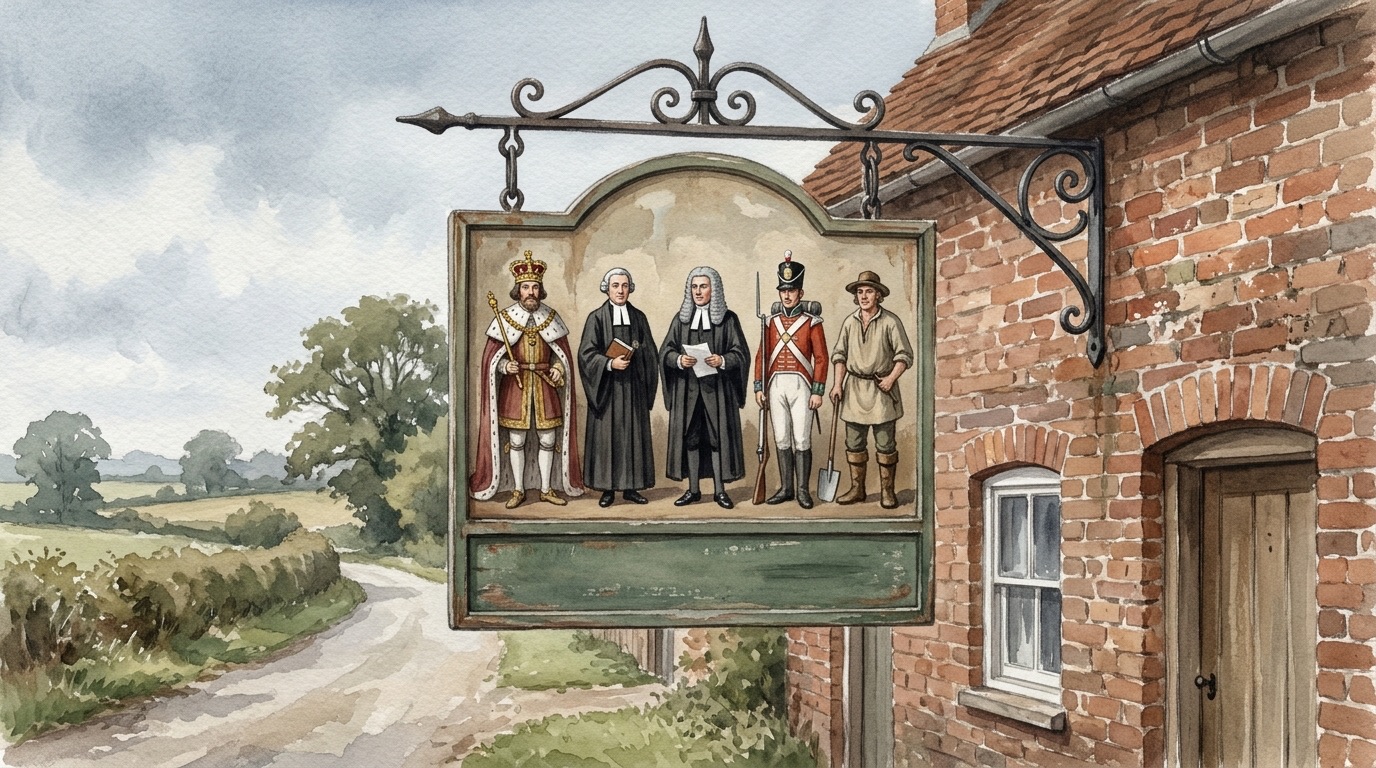
The Five Alls: the king rules for all, the parson prays for all, the lawyer pleads for all, the soldier fights for all, and the farmer pays for all. Our own artist's impression of the kind of sign that gave a Broyle beer shop its name in 1851.
North of Chichester's city walls, the road runs out across the Broyle towards the old barracks. In March 1851 the census enumerator walked that way, and in the space of a few doors he passed three beer shops, each with a name and each kept by someone with a story.
Three doors, three names
The page he wrote that evening (HO 107/1653) lists them in order along what he called the New Broyle:
- The Dog & Partridge Beer Shop, kept by Thomas Griffith, 46, a beer retailer born at Ripley in Surrey, with his wife Harriett and three of their children. His son George, 20, was a groom.
- The Chinese Dragon Beer Shop, kept by Charles Ducker, 24, born at Plympton in Devon, and his wife Mary Ann, 22, from Cromer in Norfolk.
- The Five Alls Beer Shop, kept by Charles Heath, 45.
Two doors along from the Dog & Partridge lived Charles Harrington, 41, whom the enumerator described as a Chelsea pensioner: a soldier who had served his time and drew his pension from the Royal Hospital at Chelsea. Beyond the Chinese Dragon the enumerator noted three empty houses, and then came the Five Alls.
The sailor at the Five Alls
Charles Heath's entry is the one that stops you. Against his name the enumerator wrote "Beer Retailer & Greenwich Pensioner." Greenwich Hospital paid the pensions of men who had served in the Royal Navy, so the keeper of the Five Alls was a navy man ashore.
His children's birthplaces read like a career on the coast. His eldest, Elizabeth, 18, a dressmaker, was born at Reculver in Kent. Her brothers Charles, George and William were born at Niton, Chale and St Lawrence, three villages along the south coast of the Isle of Wight. His wife Caroline came from Petersfield. By 1851 the family was living on the Broyle, and he was selling beer along the road from the barracks.
The name over his door was an old joke that every customer would have known. A Five Alls sign showed five figures: the king who rules for all, the parson who prays for all, the lawyer who pleads for all, the soldier who fights for all, and the farmer who pays for all. With a Chelsea pensioner a few doors up and the barracks along the road, the soldier on the sign was among friends.
The barracks on the Broyle
The beer shops had good reason to be there. The barracks on the Broyle began in tents in 1795, at the time of the French wars, and wooden huts followed in 1803. During the Napoleonic wars French prisoners were held at the camp, and according to the Novium Museum in Chichester it was prisoners of war who began building the flint and brick boundary wall in 1814. The barracks went on to serve the Royal Sussex Regiment and later the Royal Military Police, who left in 2005. Three historic pieces survive on the site, which is now housing: the chapel, the keep and the wall.
What came after
By 1859 the Post Office directory lists the Wellington Arms at what became 67 Broyle Road, and by the 1860s there was an Inkerman Tavern on the New Broyle Road, a name that recalls the Crimean battle of 1854. In 1925 the Bee Hive on Broyle Road was one of the beerhouses the city's licensing justices reviewed.
Broyle Road still has a pub: the Bell Inn, opposite the Festival Theatre.
If you are researching a house on the Broyle
A few things we have learned the hard way:
- Look for the house name in the address column. The enumerator wrote "Five Alls Beer Shop" where a house number would go. In 1851 a building's name was often the only address it had.
- Pensioners tell you where to look next. A Chelsea pensioner had served in the army, a Greenwich pensioner in the navy. Their service and pension records can follow a man back through decades before he came to your street.
- Children's birthplaces are a route map. Charles Heath's family can be traced from Reculver to the Isle of Wight from the census alone, before a single service record is opened.
- Street names moved. The New Broyle of 1851 may not match any street name on a modern map. Match the census to a map of the same date before you decide which house was which.
Census returns, directories, maps and service records between them can put a name to almost every building on a road like this one. If you would like to know who lived in your own house, and what was going on outside its front door, that is exactly what a house history sets out to find.