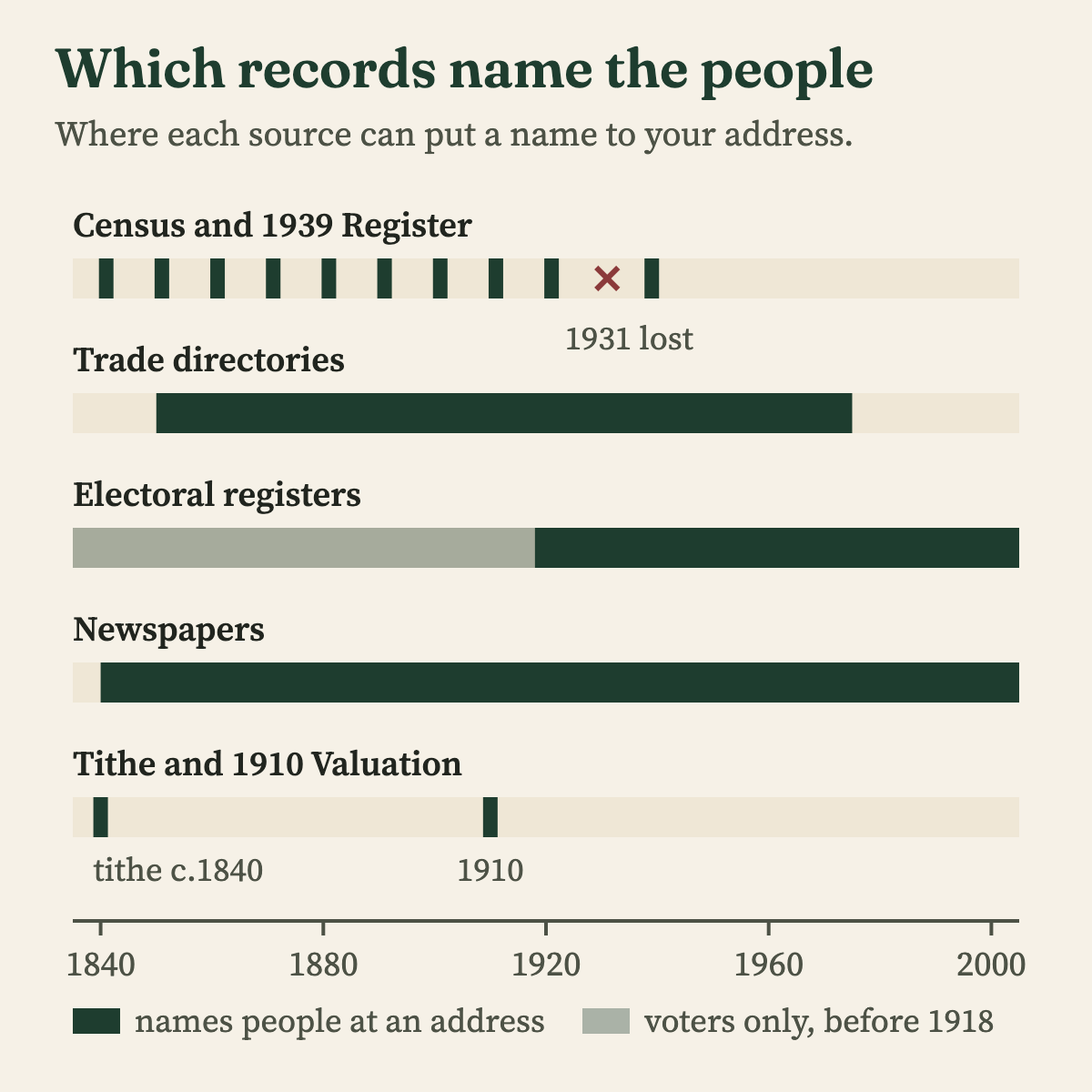
You can find most of the people who lived in a UK house from the census, which names every household from 1841 to 1921, and the 1939 Register. Electoral registers and trade directories fill the years in between, and old newspapers turn the names into people. Work backwards from today, one source at a time, and keep a simple list of who was there in which year.
If you don't yet know roughly when the house was built, start with when was my house built. There is no point searching the 1851 census for a house that went up in 1890.
Which census years can I search?
In England and Wales the census was taken every ten years from 1841 to 1921, and every return lists the people in each household with their ages and jobs, and from 1851 their birthplaces. The 1931 returns were destroyed in a fire during the war and no census was taken in 1941. The records are searchable on Ancestry, Findmypast and TheGenealogist.
Search by street, not by house number. Numbers were often missing in early returns, and many streets were renumbered, so the family at "No. 12" in 1881 may be living in today's No. 24. Village houses usually had no number at all. Look at the neighbours on either side: if they match from one census to the next, you have the right house even when the number has changed.
The 1921 census is worth opening even if 1911 already answered the question. It is the only census for England and Wales that names each worker's employer.
What did the 1939 Register record?
On 29 September 1939 every civilian in England and Wales was listed, with their exact date of birth and occupation, so that identity cards and ration books could be issued. It fills the gap left by the lost 1931 census. Entries for people who may still be alive remain closed, but most households from 1939 are open on Ancestry and Findmypast.
How do electoral registers and directories fill the gaps?
Electoral registers list the adults entitled to vote at each address, year by year. They become much more useful after 1918, when most men and many women got the vote. They show exactly when a family arrived and left, which the census, taken once a decade, cannot. Some are online at Ancestry and Findmypast. Local libraries and record offices hold the rest.
Trade directories, such as Kelly's, list householders street by street from the Victorian period to the 1970s. They are strongest for main roads, shops and the better-off, and thinner for back streets.
How do newspapers bring the names to life?
Once you have names, search the British Newspaper Archive (also included in Findmypast's top subscription) for the address itself. Put it as the papers printed it, with the comma: "12, Victoria Road" followed by the town. You will find births, marriages and deaths "at her residence", lodgers wanted, court cases, and auction notices.
An auction notice for the house is the best description of it you will ever get. They often list every room and fitting, and sometimes the outbuildings that have since gone.
Can I trace who owned it, not just who lived there?
Owners and occupiers were often different people. Until well into the 20th century most houses were rented, and the census records the tenant. For the owners, look at:
- the 1910 Valuation Survey, which names both the owner and the occupier of every property in England and Wales
- the tithe schedule of around 1840, which does the same for each plot
- your deeds, or the Land Registry title, for the more recent owners
- the probate calendar on GOV.UK, which gives the address of everyone whose will was proved from 1858, once you have a name to search
How do I find old photographs of my house?
Try Britain from Above, which has free aerial photographs from 1919 onwards, and the Historic England Archive. Francis Frith's collection of postcards covers thousands of towns and villages. Your county's local studies library will often have street photographs that are not online. Old sale particulars sometimes include a photograph, and Google Street View's history goes back to around 2008, which can show a front garden or a shopfront that has since changed.
The best photographs are often in private hands. A previous owner's family, or a long-standing neighbour, may have the only picture of the house before it was extended.
What about Scotland and Northern Ireland?
In Scotland the census and the valuation rolls, which name owners and occupiers, are on ScotlandsPeople. In Northern Ireland only the 1901 and 1911 censuses survive complete, and both are free online. The Public Record Office of Northern Ireland holds the valuation revision books, which track who occupied each property over several decades.
Want someone to do it for you?
Finding the names is the start. Turning them into the story of a house, with every family in order and the gaps explained, takes longer. My house history research does exactly that: I search the online records above and more, and send you the finished history as a printed booklet.