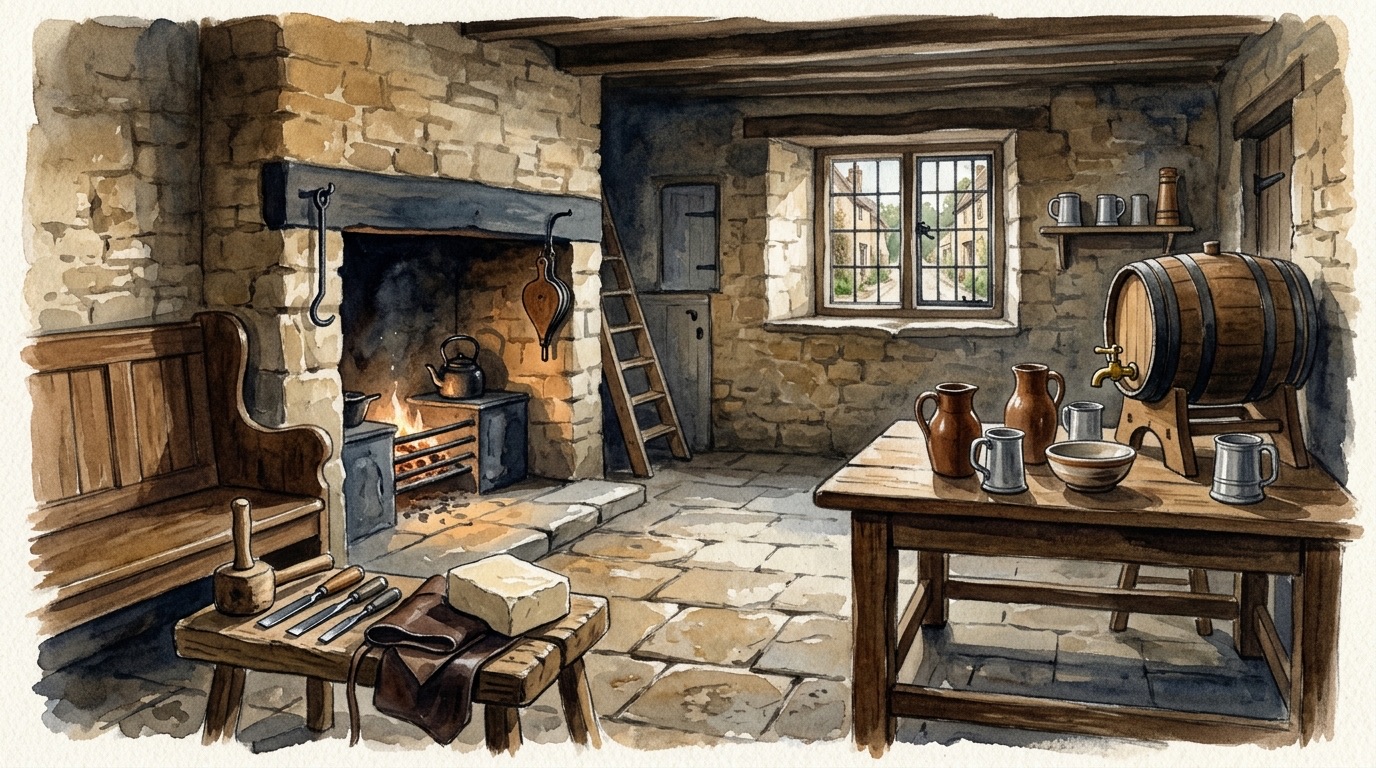
A front-room beerhouse of the kind Richard Jones kept on Cricklade Street in 1851, with a mason's tools by the hearth. An artist's impression, not a picture of his house.
Cricklade Street today is a busy run of shops on the way into the centre of Cirencester. In 1850 it was something else as well: the street where the town drank, and the street where its beer was made.
Nine doors on one street
Slater's Directory of Gloucestershire for 1850 lists five public houses on Cricklade Street:
- The Bell, kept by William Mills.
- The Bishop Blaize, kept by Robert Yaxley.
- The Salutation, kept by Thomas Trenery.
- The Three Horseshoes, kept by Alexander Sealey.
- The Wheatsheaf, kept by Mary Berry.
The same directory names four more people on the street as retailers of beer: Richard Jones, John Oliver, William Short and Charles Whethorn. So a Cricklade Street man in 1850 had at least nine doors to choose from, and that is before he walked up into the Market Place.
Most of them were not new. Pigot's directory of 1830 already has the Wheat Sheaf (kept by Sarah Blizzard), the Bishop Blaize (Richard Cole), the Three Horse Shoes (W. Collier) and the Bell (Joseph Parson) on the same street.
The name of the Bishop Blaize is worth a moment. St Blaise was the patron saint of wool combers, and an inn sign with his name on it in a Cotswold wool town is unlikely to be a coincidence.
The beerhouses: a pint in someone's front room
Below the inns sat a humbler tier. The Beerhouse Act of 1830 allowed any ratepaying householder to sell beer from their own home on payment of a small excise fee, with no magistrates' licence needed until 1869. The result was a scattering of front-room bars, kept in ordinary houses by people who usually had another trade.
The 1851 census lets us look inside one of them. On Cricklade Street the enumerator found Richard Jones, 30, born in Cirencester, and wrote his occupation in full: "Beerhouse Keeper & Mason." He lived with his wife Mary Ann, 36, and their sons Robert, 8, and George, 6. A stonemason's tools by day and a barrel in the front room by night: in a town built of Cotswold stone, it is hard to think of a more Cirencester way to earn a living. His next-door neighbour on the page was Joseph Evans, a shoemaker.
The brewery on the street
Cricklade Street did not only sell beer. It made it.
Pigot's 1830 directory lists Joseph Cripps & Co., brewer, on Cricklade Street, and two maltsters on the same street. According to the Brewery History Society, the business had been founded in 1798 and grew out of the brewhouse of the Bell Inn, a late medieval building on Cricklade Street that brewed for itself and for several other local houses.
Under the Cripps family it became the Cirencester Brewery, registered as a company in the late 1880s. Kelly's directory of 1889 lists "Cirencester Brewery Lim., brewers" on Cricklade Street, with its company secretary and a brewer's traveller living on the same street. The firm was taken over by H & G Simonds of Reading in 1937, when brewing ended, and the Bell and the main brewhouse block were demolished before 1939.
What changed
By 1889 the street had moved on, but not far. Kelly's directory that year has the Bishop Blaize (William Dean), the Wheatsheaf (George Watts), the King's Head public house, and two beer retailers, Henry Cuss and Otto Danneman, still trading on Cricklade Street.
The Three Horseshoes lost its licence in 1917. The Bishop Blaize closed in the early 1960s and its building was replaced by shops.
The Wheatsheaf's building still stands. Historic England dates it to the late seventeenth or early eighteenth century, built of coursed limestone under a stone slate roof, and lists it at Grade II. It closed as a pub in 2022.
If you are researching a house on Cricklade Street
A few things we have learned the hard way:
- The numbers changed. The Wheatsheaf was 129 Cricklade Street in Kelly's 1889 directory and is 79 today. A house number in an old directory is a clue, not an address, until you have matched it to a map of the same date.
- Cricklade is also a town. Richard Jones's son Robert was born in Cricklade, in Wiltshire, a few miles away. A search for "Cricklade" brings back both the street and the town, and it is easy to follow the wrong one.
- Beer sellers had day jobs. Richard Jones appears in the census as a beerhouse keeper and a mason. Search the census by occupation and you find people a directory lists under one trade only.
- Read the page, not just the index. An index gives you a name. The page gives you the neighbours, the order of the houses along the street and the handwriting, which is where most of the story is.
Trade directories, census returns, maps and the local papers between them can put a name to almost every building on a street like this one. If you would like to know who lived in your own house, and what was going on outside its front door, that is exactly what a house history sets out to find.