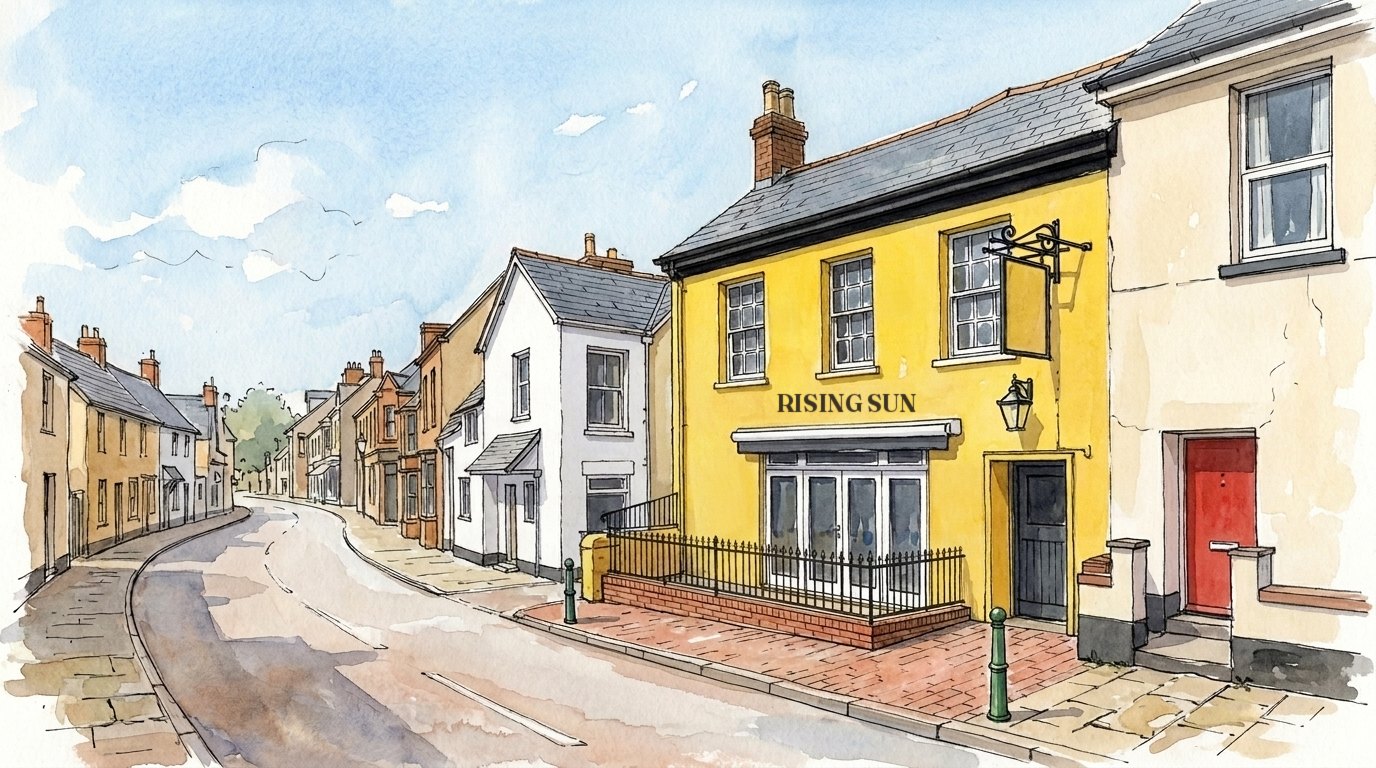
The Rising Sun, 29 Newport Road, as it stands today: our own artist's impression. It has been trading here, first as the Sun, since at least 1830.
Walk up Newport Road in Barnstaple today and it feels like any long, pleasant suburban street. In 1850 it was something else: the main street of a separate little town, with its own inns, its own beerhouses and a width that only makes sense once you know what it was built for.
A town the bishop built
Newport was never meant to be a suburb. It was a planned borough, founded by a Bishop of Exeter inside his own manor of Bishop's Tawton to rival the river port of Barnstaple next door. It won a weekly market and a three-day fair in 1294, became a borough the following year, and elected its own mayors until 1752.
That is why the street is so wide. Newport Road was laid out as a market place, and the houses that crowd its edges today were built, house by house over centuries, onto the margins of it.
By 1850 the port trade had long gone (a causeway across the Coney Gut in the seventeenth century had drained the marsh and cut the town off from the tide), and Newport had been folded into the borough of Barnstaple in 1836. However, it still kept the habits of a town of its own, and nowhere more than in its drinking.
The three inns
White's Directory of Devonshire for 1850 lists three fully licensed houses at Newport:
- The Rose & Crown, kept by William Baker, at the top of the street.
- The Rising Sun, kept by William Squire.
- The Newport Inn, kept by Joseph Perrien.
The Rising Sun was already old by then. It appears in Pigot's Directory of 1830 simply as the Sun, kept by George Gould, and the same name turns up on a Barnstaple list of 1837 as the "Sun Inn". Its licensees run in an almost unbroken line from there: William Pitts in 1844, Squire in 1850, Joseph and then James Bradford, Henry Oatway, John James Terry, and from at least 1910 to 1923, Herbert Frederick Jones.
Pubs did far more than serve beer. In 1894 the Borough Coroner held an inquest in the Rising Sun's rooms, a perfectly ordinary use for the largest public room in a neighbourhood. In 1870 a landlord's daughter was born on the premises and announced in the North Devon Journal like any other birth. In 1941 the Western Times reported that Mr and Mrs Jones of the Rising Sun had celebrated their diamond wedding, at 81 and 85; Mrs Eva Jones died there the following January. By 1948 the pub was fielding a team in the town's pub games league.
The Newport Inn did not last: by 1897 it had closed, along with two other Newport houses, the Prince of Wales and the Ebrington Arms. The Rising Sun outlived them all, and it is still trading at 29 Newport Road today.
The beerhouses: a pint in someone's front room
Below the inns sat a humbler tier that most local histories forget. The Beerhouse Act of 1830 allowed any ratepaying householder to sell beer from their own home on payment of a small excise fee. No magistrates' licence was needed until 1869. The result was a scattering of front-room bars, run out of ordinary terraced houses by people who usually had another trade.
White's counted 26 beerhouses in Barnstaple in 1850, and three of them were at Newport, kept by William Featherstone, John Edwards and Mary Ward.
The 1851 census lets us look inside one of them. On Newport Road the enumerator found William Featherstone, 55, born at Chulmleigh, and wrote his occupation in full: "Joiner & beer house keeper." He lived with his wife Grace and their daughters: Emma, 19, a milliner; Lucy, 17, a dressmaker; and Martha, 12, at school. A joiner's bench, a barrel in the front room and two young women making hats and dresses, all under one roof on an ordinary street. That was what a Victorian beerhouse usually looked like.
So in 1850, on a street the 1851 census shows was home to some 540 people, a thirsty Newport man had at least six doors to choose from.
What changed
Three years later the cutting of Victoria Road in 1853 tied Newport firmly into Barnstaple, and the second half of the century filled its fields with Victorian villas and terraces. The 1869 licensing changes squeezed the front-room trade, and the inns thinned out. A Wesleyan chapel opened on the street in 1889, followed by the present Methodist church in 1910.
What survives is the shape: a street wide enough for a medieval market, and one pub that has been pouring beer on it for nearly two hundred years.
If you are researching a house in Newport
A few things we have learned the hard way:
- Search under Bishop's Tawton, not Barnstaple. Newport sat in Bishop's Tawton parish until 1885, so baptisms, marriages, rates and the tithe map before then are all filed there. Searching "Barnstaple" alone silently misses them.
- There were two Rising Suns. Barnstaple had another in Boutport Street. The newspapers always say which, but about half of all search results belong to the other one.
- The street changed its name. Older documents call it Newport Street rather than Newport Road.
- Do not trust a nil from the 1851 occupation index. A search for beerhouse keepers on Newport Road in 1851 returns nothing, even though Featherstone is right there. Read the pages instead.
Trade directories, the tithe apportionment, census returns and the local newspapers between them can put names to almost every building on a street like this one. If you would like to know who lived in your own house, and what was going on outside its front door, that is exactly what a house history sets out to find.